.png)
Mileage Tracking for Tax Savings: Apps vs. Logs (Which Does the IRS Prefer?)
If you're driving for your business, you're probably sitting on a pretty nice tax deduction. At 72.5 cents per mile for 2026, those trips to client meetings, the hardware store, and supplier visits add up fast. But here's the million-dollar question I get every tax season: Should you use an app or stick with good old-fashioned paper logs?
The short answer? The IRS doesn't actually care which one you choose. What they do care about is whether your records are accurate, complete, and timely. Let's break down what that really means and help you figure out which method works best for your business.
What the IRS Actually Wants to See
Before we dive into apps versus logs, let's talk about what the IRS is looking for when they review your mileage deduction. It's not about being fancy, it's about being thorough.
Your mileage documentation needs to include these five things, no matter what format you're using:
1. The date of each trip Not just "sometime in March." The actual day.
2. Starting point and destination "Office to Home Depot on Main Street" works. "Around town" doesn't.
3. Business purpose Why did you make this trip? "Pick up materials for Johnson project" is perfect. "Errands" is not.
4. Miles driven The actual distance for that specific trip.
5. Odometer readings You need your total mileage at the beginning and end of the tax year to prove your business-use percentage.
The IRS also wants these records to be contemporaneous, fancy tax-speak for "written down when it actually happened, not six months later when you're scrambling before your tax appointment." This is where a lot of people trip up.
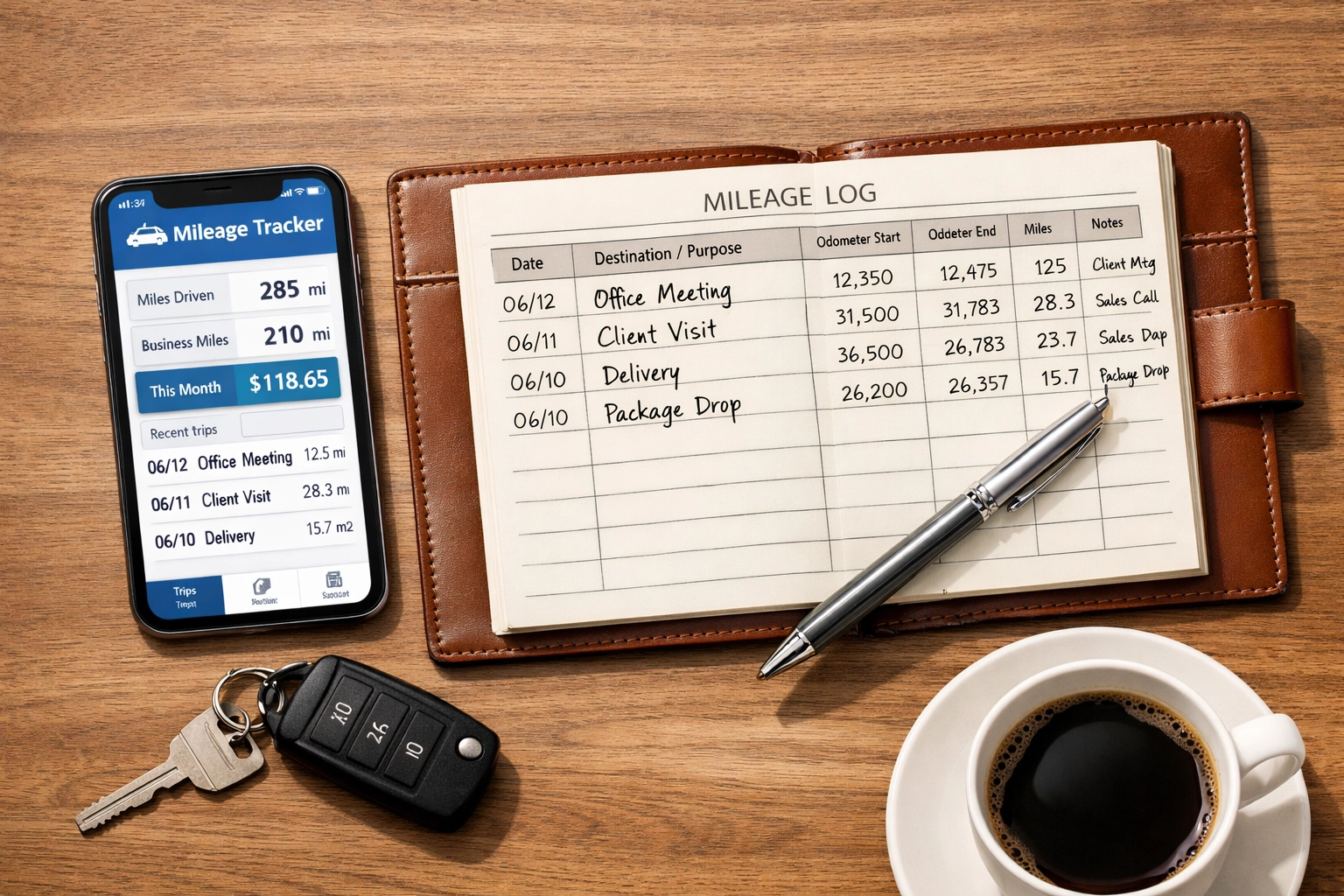
The Case for Mileage Tracking Apps
Let's be honest, we all have our phones with us constantly anyway. Mileage apps take advantage of that fact and automate a lot of the heavy lifting.
The Big Advantages:
Apps automatically capture the date and time of your trip, which means you're automatically creating those contemporaneous records the IRS loves. You hop in your car, the app starts tracking, and boom, you've got a timestamped record.
No more squinting at your own handwriting six months later trying to figure out if that says "47 miles" or "41 miles." Apps eliminate calculation errors and produce clean, professional-looking reports that you can hand directly to your accountant (who will probably thank you).
Most good mileage apps also use GPS to track your route automatically. You can categorize trips as business or personal with a quick swipe, and many will even learn your regular routes over time.
The Downsides:
Apps usually cost money, anywhere from a few bucks a month to $10-15 for premium versions. You'll also need to remember to keep your phone charged and the app running (or set to auto-track).
There's also a learning curve. You need to actually set up the app, customize your settings, and get in the habit of categorizing trips. Some people find this annoying, especially if technology isn't their thing.
The Case for Manual Logs
Now, let's talk about the old-school method: writing things down. Whether that's a notebook in your glove compartment, a spreadsheet you update weekly, or a PDF template you print out, manual tracking is still 100% IRS-compliant if you do it right.
The Big Advantages:
It's free. You don't need a subscription, an app, or even a smartphone. A $2 notebook and a pen will do the job just fine.
Some people genuinely prefer the tactile experience of writing things down. If that's you, don't let anyone tell you you're doing it wrong. Paper logs work perfectly well when maintained properly.
You also have complete control. No worries about app updates, subscription renewals, or wondering what happens to your data if the company goes out of business.
The Downsides:
Manual logs require serious discipline. You need to write down every single business trip at the time it happens, not at the end of the week, not at the end of the month. This is where most people fall short.
Handwriting can be messy, numbers can be transposed, and simple math errors can throw off your entire deduction. I've seen beautiful, detailed mileage logs that were undone by addition mistakes.
There's also the risk of losing your records. That notebook can fall out of your car, get coffee spilled on it, or just disappear into the abyss of your back seat.
So Which Method Should You Choose?
Here's my take after years of reviewing mileage logs for clients: Choose the method you'll actually use consistently.
A perfect mileage app doesn't help you if you forget to turn it on half the time. A detailed logbook template doesn't matter if it's buried under fast food receipts in your console.
Go with an app if:
You're comfortable with technology
You want automatic tracking and reminders
You drive frequently for business
You want reports ready to go at tax time
You can afford the monthly subscription
Stick with manual logs if:
You prefer writing things down
Your business mileage is minimal
You're disciplined about recording trips immediately
You want zero ongoing costs
You have a simple routine with regular routes
You can also do a hybrid approach. Some of my clients use an app for daily tracking but keep a backup logbook in their car for times when their phone dies or they forget to start the app.
Common Mileage Tracking Mistakes (That Cost You Money)
Whether you choose apps or logs, avoid these traps:
Forgetting about commuting rules: Your drive from home to your regular office isn't deductible. But drives from your home office to client sites? Those count.
Rounding everything: "Eh, about 20 miles" won't cut it. Be specific.
Waiting until tax time: Trying to recreate six months of driving from memory is a recipe for an audit nightmare. The IRS can: and will: throw out your entire mileage deduction if your records aren't contemporaneous.
Mixing business and personal: If you stop at the grocery store on the way back from a client meeting, split that trip properly. Don't claim the whole thing as business.
Not keeping backup documentation: Especially for unusual trips or high-mileage days, keep supporting evidence like appointment confirmations or project invoices.

How Much Money Are We Actually Talking About?
Let me put this in perspective with a real example. Say you drive 10,000 business miles in 2026. At 72.5 cents per mile, that's a $7,250 deduction. If you're in the 24% tax bracket, that saves you about $1,740 on your tax bill.
Worth tracking? I'd say so.
But here's the thing: if your records are sloppy or incomplete and you get audited, the IRS can disallow the entire deduction. All $7,250 of it. Plus penalties and interest.
That's why I always tell clients: tracking your mileage properly isn't just about getting a deduction. It's about protecting that deduction if the IRS comes knocking.
Setting Yourself Up for Success
Whatever method you choose, do these three things right now:
Record your odometer reading today. Write down your current mileage and the date. You'll need this at year-end to calculate your business-use percentage.
Create a system and commit to it. Whether that's downloading an app, buying a logbook, or creating a spreadsheet template, set it up this week. Not next month. This week.
Keep your records for at least three years from the date you file your return. The IRS can audit you within that window, and you'll need documentation to back up your deduction.
The bottom line? The IRS genuinely doesn't prefer apps over manual logs or vice versa. They just want to see that you're keeping accurate, timely, complete records of your business driving. Choose the method that fits your work style and stick with it consistently.
Need help getting your bookkeeping and tax prep organized? That's exactly what we do at Your Business Accountant. We can review your current mileage tracking setup and make sure you're maximizing your deductions while staying audit-proof.
Comments